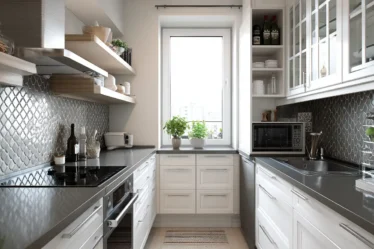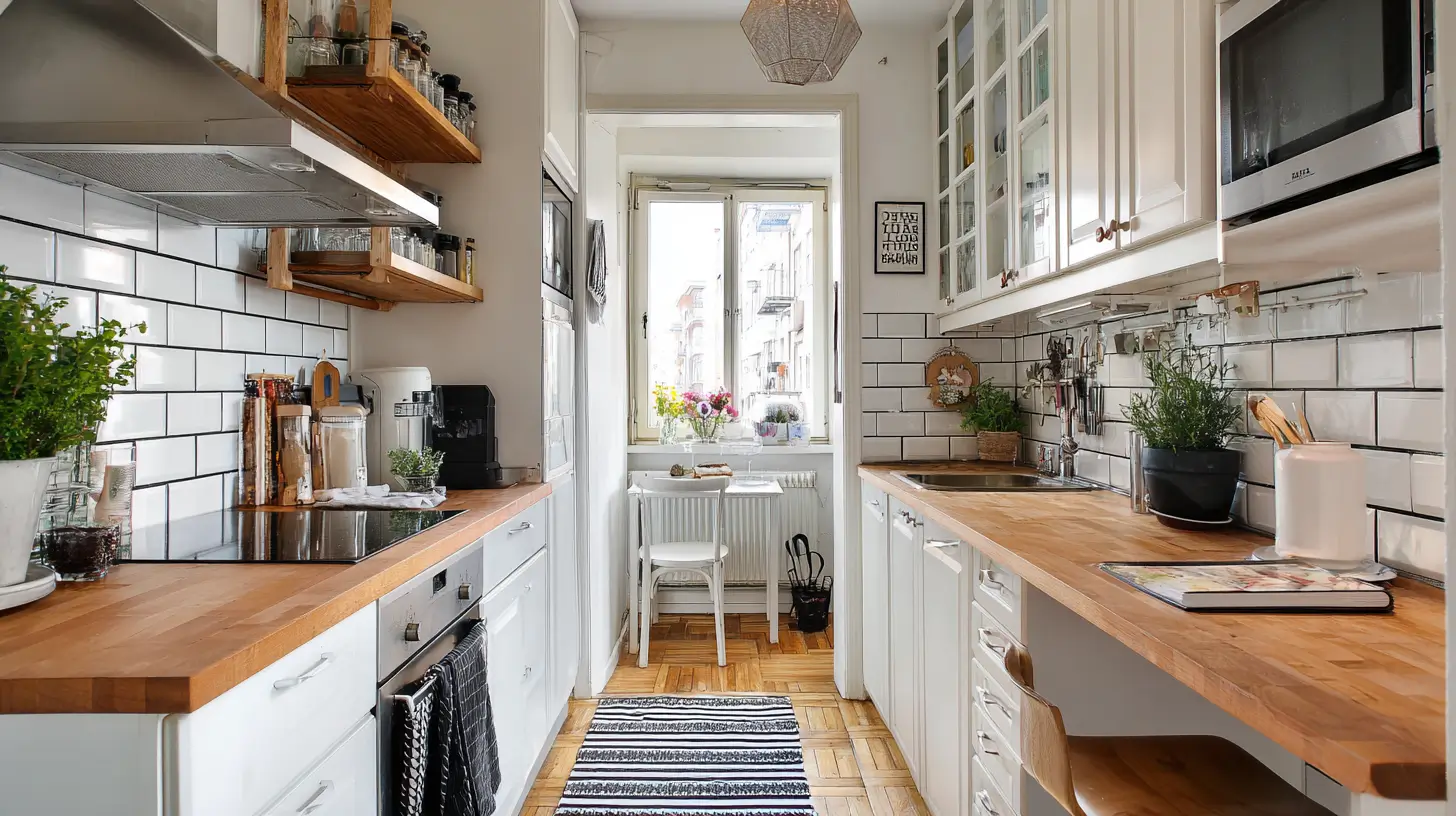
You open a cabinet and something falls out. Again.
The counter has maybe six inches of clear space. Your coffee maker fights your toaster for territory. And every time you try to cook a real meal, you end up frustrated before the water even boils.
Sound familiar? You are not alone.
Small kitchens are one of the most common complaints from renters and homeowners across the US. And the problem is not that your kitchen is too small. The problem is that most small kitchens are set up wrong. Wrong storage. Wrong layout. Wrong habits.
The good news? You do not need a renovation. You do not need to spend thousands. These 18 small kitchen ideas will show you how to maximize kitchen space using what you already have, plus a few affordable upgrades that actually work in 2026.
Pick three ideas and start this week. That is all it takes.
1. Go Vertical Because Your Walls Are Doing Nothing

Most small kitchens stop at eye level. Everything gets stuffed into cabinets and piled on counters. Meanwhile, three feet of perfectly good wall space above your cabinets just sits there collecting dust.
Your walls are storage. Start treating them that way.
Mount open shelves from counter height all the way to the ceiling. The top shelves hold rarely used items. The middle shelves hold everyday dishes. This frees up your lower cabinets for things that are harder to store anywhere else.
A pegboard is one of the best small kitchen storage solutions you can buy for under $20. The IKEA SKÅDIS system is a popular choice and starts at around $15. You hang it on the wall and use hooks, bins, and shelves to hold tools, spice jars, lids, or even small pots. Everything is visible. Nothing gets buried.
Add a magnetic knife strip to the wall instead of keeping a knife block on the counter. That block takes up more counter space than most people realize.
Finally, put a shelf riser on top of your refrigerator. That flat surface above your fridge is one of the most wasted spots in any kitchen. A small shelf there holds cookbooks, a fruit bowl, or seldom used appliances.
Start here if your counters are always cluttered. Going vertical clears counter space without throwing anything away.
2. Remove Two Cabinet Doors and Open Up the Room

This sounds too simple. It works anyway.
Pick one section of upper cabinets, the ones at eye level that you open most often. Remove the doors. Just unscrew the hinges and set the doors aside.
What happens next is interesting. The room immediately feels bigger. Solid cabinet doors create a visual wall. Open shelves break that up and let the eye travel deeper into the space.
There is another benefit that most people do not expect. Open shelves force you to stay organized. When everything is visible, you stop letting things pile up. You keep only what looks good or what you actually use.
Style the open section with matching containers or uniform jars. This makes the shelves look intentional rather than messy. Mason jars for dry goods, matching mugs stacked neatly, a few plants or small items for personality.
This idea costs nothing if you already have the cabinets. And removing just two to four doors can create the feeling of 20 to 30 percent more visual space, according to interior designers who specialize in small kitchens.
One warning: This works best for dishes and dry goods you want to see. Do not open up the cabinet under the sink.
3. Get a Rolling Kitchen Cart for Extra Counter Space

A rolling cart is one of the most practical small kitchen ideas on this list.
Here is why. It gives you counter space and storage. And when you do not need it, you roll it away. That flexibility is something a fixed island can never offer.
In a galley kitchen or studio apartment, a rolling cart can add six to twelve square feet of usable prep space. Use the surface to chop vegetables, plate meals, or set up a coffee station. Use the bottom shelf to store a stand mixer, bulk bags, or extra pantry overflow.
Most carts have hooks or side rails where you can hang dish towels, utensils, or reusable bags. Some have built in drawers.
Butcher block carts start at around $60 on Amazon and go up to $250 for stainless steel or larger sizes. Rolling kitchen carts have consistently ranked among the top ten best selling kitchen furniture items on Amazon through 2024 and 2025.
If you have a narrow kitchen, look for carts that are 18 inches wide or less. They roll through doorways and fit into hallway spaces when not in use.
Best for: Galley kitchens, studio apartments, or any kitchen that needs more prep space without a permanent footprint.
4. Declutter Before You Organize Anything Else

Here is the mistake most people make. They buy bins, baskets, and drawer dividers. Then they organize everything they own into them. Then they wonder why it still feels crowded.
You cannot organize your way out of too much stuff.
The only real fix is to reduce what is in the kitchen before you try to store it better. And most kitchens hold two to three times more items than the household actually uses on a regular basis, according to professional organizers.
Start with the one year rule. If you have not used something in the last twelve months, it does not belong in the kitchen. That waffle maker you used once. The four spatulas. The blender that takes fifteen minutes to clean. They all take up space that your daily items desperately need.
Duplicates are the worst offenders. Most households need one good spatula, not four. One cutting board out, one in reserve. One colander.
Appliances you use less than once a month should live somewhere else. A closet, a cabinet in another room, anywhere but your kitchen counter or prime cabinet space.
Empty space is not wasted. It is room to breathe and room to cook without bumping into things.
5. Add Pull Out Drawers Inside Deep Cabinets

Deep cabinets are a trap.
You put something in the back and forget it exists. Then you buy a second one. Then you discover the original two years later when you are reorganizing. This is what happens to nearly every deep cabinet without a system.
Pull out drawer inserts solve this completely. They slide on rails inside the cabinet and bring the back contents to the front. You can see and reach everything without digging.
These are available at The Container Store, IKEA, and Amazon. Most are DIY friendly and slide onto standard cabinet rails without any special tools. Prices start around $20 to $40 per insert.
The two places where pull outs make the biggest difference are under the sink and inside corner cabinets. Both are notoriously hard to reach. Both tend to become black holes of forgotten cleaning supplies and mismatched lids.
Lazy Susans have been the traditional solution for corner cabinets. Pull out shelves are more efficient because they use the full width of the cabinet instead of wasting the corners of a spinning tray.
Bonus: Once you can see what you have, you stop buying duplicates. Pull outs pay for themselves.
6. Store Things on the Inside of Cabinet Doors

Look at the inside of your cabinet doors right now.
That surface is completely flat. It is unused. And it can hold more than you think.
A small spice rack mounted on the inside of a pantry door holds twelve to twenty spice jars without taking up a single inch of shelf space. Over the door hooks hold pot lids, measuring cups, cleaning supplies, or foil and wrap rolls.
Under the sink is one of the best places to use this trick. Mount a small rack or hooks on the inside of that door to hold spray bottles, rubber gloves, or scrub brushes. The floor of the cabinet stays clear for bigger items.
If you rent and cannot put screws in doors, Command strips and adhesive hooks work for lighter items. They hold surprisingly well and come off cleanly.
Cabinet door organizers have become one of the fastest growing small kitchen product categories on both TikTok Shop and Amazon through 2024 and 2025. The category is growing because the idea works.
This is zero footprint storage. You are not adding anything to your kitchen. You are just using space that currently does absolutely nothing.
7. Replace Three Appliances with One Multifunctional Unit

Count the appliances on your counter right now.
Toaster. Toaster oven. Air fryer. Coffee maker. Maybe a rice cooker. Each one takes up eight to twelve inches of counter space. Together they can eat an entire counter.
The fix is not to stop cooking. The fix is to consolidate.
Multi function countertop ovens like the Breville Smart Oven Air Fryer or the Ninja Foodi replace your toaster, toaster oven, and air fryer with one machine. You get the same functions in the footprint of a single appliance. The Breville consistently ranks among the top selling countertop appliances on Amazon and Best Buy.
If you live in a studio with a small stovetop, a two burner portable induction cooktop can actually be more efficient and uses far less surface area than a dedicated range.
For apartments without dishwashers, countertop dishwashers exist. They connect to your faucet and fit on the counter. They are not perfect for large households, but for one or two people they are a real option.
Nesting cookware sets are worth mentioning here too. They stack completely flat inside each other and cut cabinet use dramatically compared to traditional pots and pans.
The rule: If you use it every day, it earns counter space. If you use it once a week, it goes in a cabinet. Once a month or less, it moves out of the kitchen entirely.
8. Use Light Colors to Make the Kitchen Feel Bigger

Dark cabinets and dark walls shrink a room. Light colors do the opposite.
You do not need to repaint the whole kitchen. A few targeted changes make a real difference.
Peel and stick backsplash tiles in white or light gray are one of the most searched DIY kitchen upgrades on TikTok and YouTube going into 2026. They cost $20 to $60 for a full backsplash area and take about two hours to apply. They are also renter friendly since they come off without damage.
Contact paper in white or marble patterns transforms countertops that are dark, chipped, or stained. A full counter can be covered for under $30.
For cabinets, white and off white paint continues to be the most popular choice for small kitchens. Warm gray and soft sage are the trending alternatives for 2026 if you want color but still need the light reflecting effect.
One technique that designers use in small kitchens is to paint upper cabinets lighter than lower cabinets. It pulls the eye upward and makes the ceiling feel higher.
Replace any warm yellow light bulbs with LEDs in the 3000K to 4000K range. They produce cleaner, brighter light that amplifies every light colored surface in the room.
Light colors do not just look good. They make the kitchen feel physically larger. That is a real psychological effect, not just a design preference.
9. Add Under Cabinet Lighting for an Instant Upgrade

This is one of the cheapest and most effective small kitchen upgrades you can make.
A dark kitchen feels small, heavy, and harder to work in. Lighting up your counters from underneath creates depth, improves visibility, and makes the space feel more open.
LED strip lights and puck lights are the two most common options. Both install with adhesive backing. No electrician required. No drilling. No tools.
LED strip light kits start at $15 to $30 on Amazon and cover a full kitchen counter run. Puck lights are slightly easier to position and are available in battery powered versions for renters who cannot plug anything in under the cabinets.
The visual effect is real. When light hits the counter from above and below, the upper cabinets appear to float. The kitchen looks bigger and more polished without any structural changes.
Home stagers consistently rate under cabinet lighting as one of the highest return on investment upgrades for the cost. A $25 LED strip kit genuinely changes how a kitchen looks and feels.
Install one strip under your most used cabinet first. You will see the difference within five minutes and want to do the rest immediately.
10. Hang a Tension Rod Under the Sink

This is the cheapest trick on the entire list. It costs $3 to $8 and takes two minutes.
Buy a tension rod the width of your under sink cabinet. Extend it across the interior of the cabinet, about halfway up. Now hang your spray bottles by their triggers over the rod.
Every spray bottle lifts off the floor of the cabinet. The entire floor is now free for larger items like trash bags, extra dish soap, or a cleaning caddy.
You can add a second tension rod for more hanging space. Some people use a third at a different height to create tiers.
This hack has been shared millions of times across TikTok and YouTube organization channels through 2024 and 2025. It keeps showing up because it genuinely works and costs almost nothing.
The same tension rod trick works inside closets, bathroom cabinets, and pantry areas. It is not limited to under the sink.
Buy a three pack. They cost under $10 total and you will find uses for all three within a week.
11. Zone Your Kitchen So Everything Is Where You Use It

Most people store things based on where there is space. Not where they use them.
This creates invisible inefficiency. You walk to the opposite side of the kitchen for a spatula when the stove is right here. You keep the coffee grinder in a cabinet three steps from the coffee maker. Small trips. Repeated ten times every morning. It adds up.
Kitchen zoning means every item lives closest to where it is used.
Coffee maker, mugs, coffee beans, filters, and a small trash bowl for grounds all belong in the same zone. Cutting board, knives, and prep bowls belong near your primary chopping space. Pots, pans, and cooking utensils belong within reach of the stove.
Create a daily use zone at counter level or in the most accessible cabinets. Everything you touch every day goes here. Create a once a week zone in slightly less convenient spots. Rarely used items go in the hardest to reach places, top shelves or back corners.
Label your zones if you share the kitchen with others. The system only works if everyone uses it.
Zoning works in any size kitchen, including kitchens under 80 square feet. You are not changing your kitchen. You are changing your logic.
12. Hang a Pot Rack and Free Up an Entire Cabinet

Pots and pans take up more cabinet space than almost anything else in the kitchen.
A pot rack moves them off the shelves and onto the wall or ceiling. You get an entire cabinet back. And your kitchen suddenly looks like it belongs in a cooking magazine.
Wall mounted pot racks start at $30 to $60. They attach to studs with two screws and hold six to ten pots and pans. Ceiling mounted racks work well above an island or cart and start around $60 to $100.
If you rent and cannot put large screws in walls, over the door pot racks exist. They hang over a pantry door or a cabinet door and hold four to six pieces.
Pot racks are one of the most recommended small kitchen storage solutions across design blogs and YouTube home organization channels going into 2025. They come up consistently because they solve a real problem with a single product.
One honest note: Wall mounted racks work best in kitchens with some clear wall space. If all your walls already have cabinets on them, a ceiling mount or over door option is your better choice.
13. Switch to Uniform Stackable Containers

Open the cabinet where you keep food storage containers. Look at it honestly.
If it is a pile of random lids, mismatched sizes, and containers rolling out when you open the door, you have a container problem. And it is wasting more space than you think.
Random containers do not stack efficiently. They leave gaps. They tip over. They make it impossible to see what you have. So you buy more.
The fix is switching to one uniform system. Square or rectangular containers stack like blocks and fill shelves efficiently. OXO Pop containers are consistently among the best sellers in kitchen storage on Amazon. IKEA 365+ containers are a budget friendly alternative. Both systems let you stack containers of different sizes without instability.
Square containers use 15 to 25 percent more of your shelf space compared to round ones of the same volume. The math matters in a small kitchen.
Decant your dry goods too. Transfer pasta, rice, oats, and flour from their original packaging into containers. The packaging is bulky and inconsistent in size. Uniform containers are not.
Labels are part of the system. Without labels, you stop using the system within a month. Label everything. It takes ten minutes and saves hours of frustration.
Start with one shelf. Make one shelf perfect. Then do the next.
14. Put a Narrow Shelf Unit Next to the Fridge or Outside the Kitchen

Your kitchen storage does not have to end at your kitchen walls.
A narrow shelving unit, six to ten inches deep, fits into spaces most people overlook. The gap beside the refrigerator. The hallway just outside the kitchen door. A dead corner near the entryway.
This kind of unit holds spices, canned goods, small appliances, cookbooks, or pantry overflow. It extends your kitchen storage without taking any space from inside the kitchen.
IKEA VITTSJÖ and RÅSKOG are two narrow shelving options that work well in these spots. Both are under $60 and assemble in under an hour. There are similar options on Amazon in the $30 to $80 range.
The key measurement to check before buying is depth. A shelf that sticks out ten inches into a hallway is barely noticeable. A shelf that sticks out twenty inches becomes a hazard.
Narrow freestanding shelving units are consistently among the top searched small kitchen furniture items on both Pinterest and Google. The demand is there because the problem is common.
Measure the gap beside your fridge right now. You may have four to six inches of space that is currently doing nothing. A slim pull out pantry unit fits in gaps that small.
15. Make Your Backsplash a Storage Zone

The backsplash is one of the most overlooked storage opportunities in any small kitchen.
That wall between your counter and upper cabinets is usually just tile. It looks nice. It stores nothing. But it can do much more.
A rail system mounted to the backsplash turns it into vertical storage. IKEA KUNGSFORS and IKEA Fintorp are two rail systems designed exactly for this. You mount a horizontal rail to the wall and hang hooks, small shelves, jars, and utensil holders from it.
A paper towel holder, a set of small spice jars, a utensil hook, and a small cutting board holder can all live on the backsplash. Every one of those items would otherwise take up counter or cabinet space.
Magnetic backsplash panels are another option. They accept magnetic knife holders, magnetic spice tins, and magnetic organizers. The whole system is rearrangeable without any drilling.
IKEA KUNGSFORS specifically comes up repeatedly as a recommended product on Reddit in communities focused on small space living, including r/malelivingspace and r/femalelivingspace through 2024 and 2025.
For renters, adhesive rails and magnetic panels require no drilling and are available on Amazon. They hold lighter items and come off walls without damage.
16. Rethink Where Your Refrigerator Sits and What Size It Is

Most people never question their refrigerator. It came with the kitchen and it stays where it is.
But your refrigerator is often the biggest fixed obstacle to good kitchen flow. Moving it even six inches, or swapping it for a different size or style, can change how the whole kitchen works.
Counter depth refrigerators sit flush with your cabinets instead of sticking out four to six inches beyond them. That protrusion is smaller than it sounds on paper, but in a tight kitchen it blocks doorways, interrupts foot traffic, and makes the room feel cramped.
If a full size counter depth refrigerator is outside your budget, a top freezer model is worth considering. Top freezer refrigerators generally offer better usable space per cubic foot compared to French door models at the same price point. They are also narrower on average.
For very small kitchens and studio apartments, a smaller refrigerator is not a compromise. Smaller refrigerators force a fresh first approach to grocery shopping, which reduces food waste and keeps the fridge from becoming a graveyard for forgotten leftovers.
Before your next move or kitchen update, measure how much your current fridge sticks out past the counters. If it is more than two inches, a counter depth swap may be one of the highest impact changes you can make.
17. Use a Fold Down Table Instead of a Fixed Dining Surface
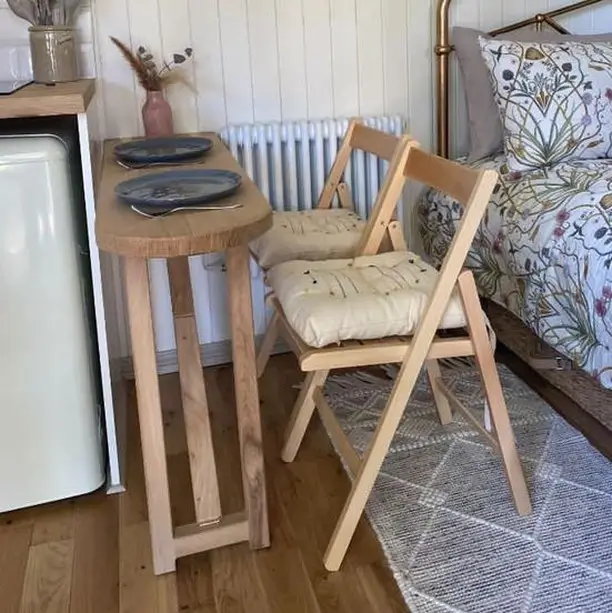
A fixed table in a small kitchen takes up the same space whether you are using it or not.
A fold down wall mounted table takes up almost no space when closed and gives you a full eating or prep surface when open.
IKEA NORBERG is the most recommended wall mounted fold down table for small kitchens. It costs around $40, mounts to studs, and folds to about five inches off the wall when not in use. When folded down, it gives you roughly twelve by eighteen inches of surface area, enough for two people eating or for extra prep space while cooking.
Drop leaf tables are a freestanding alternative. They fold on both sides and shrink to about twelve inches wide when fully collapsed. You push them against a wall and they disappear. Open one leaf and you have space for two people. Open both and you have space for four.
Both options appear consistently in small apartment guides from design publications and on YouTube apartment tour channels in 2025.
The real value here is flexibility. You get the dining or prep surface when you need it. You get the floor space back when you do not.
18. Do a Monthly Kitchen Reset for 20 Minutes

Every system falls apart without maintenance. A small kitchen falls apart faster than most.
Dishes pile up in the wrong spot. Things get left on the counter because there is no time to put them away properly. The pantry gets restocked on top of what was already there without any checking.
A monthly reset prevents this from becoming permanent.
Set a timer for twenty minutes. Clear everything off the counters completely. Wipe them down. Then return only what belongs there. Check one cabinet for expired food. Reorganize one zone if it has drifted from where it should be.
That is it. Twenty minutes once a month keeps the system working.
If a full reset feels like too much, do one zone per month instead. Pantry one month. Under the sink the next. The four main cabinets over the following four months. By the time you cycle through, the first zone is ready for another pass.
Professional organizers consistently say that maintenance, not the initial setup, is what determines whether a system lasts. The initial organization is the easy part. The reset is what makes it permanent.
Put it on your calendar right now. A recurring event the last Sunday of each month. Twenty minutes. That is the entire commitment.
Your Small Kitchen Has More Potential Than You Think
You do not need more square footage. You need better use of the square footage you already have.
Start with decluttering. Then go vertical. Then fix one storage problem at a time. None of these small kitchen ideas require a contractor, a renovation budget, or more than a weekend afternoon.
Pick the three ideas that match your biggest frustration and do those first. Maybe it is the under sink chaos. Maybe it is the counter that is always buried. Maybe it is the deep cabinet where things go to disappear.
Fix those three things this week. Then come back and fix three more.
The best small kitchen storage solutions are not complicated. They are specific, affordable, and doable. Every inch of your kitchen can work harder. You just have to decide where to start.