Your Bathroom Feels Small. Here Is the Fix.
The average American bathroom is just 40 square feet. That is smaller than most walk-in closets. And if yours feels like a shoebox every morning, you are not imagining it.
Most people try to fix a small bathroom by buying better storage or a nicer mirror. Those things help a little. But tile is the one thing that can change how big a room feels without touching a single wall.
Here is the truth: the wrong tile makes a small bathroom feel like a closet. The right tile makes that same room feel twice as open. The difference comes down to size, color, pattern, layout, and grout. That is it.
This guide gives you 20 specific tile ideas that interior designers use to make small bathrooms look bigger. Each one is clear, practical, and works in 2026. No vague advice. No guessing.
Why Tile Is the Most Powerful Tool in a Small Bathroom
Paint matters. Lighting matters. But tile covers more surface area than anything else in your bathroom. The floor, the walls, the shower surround. When you add it up, tile can cover 80 percent or more of every visible surface.
That means your tile choice affects almost everything you see when you walk in.
Color tricks your brain into reading a space as larger or smaller. Pattern creates visual noise or visual calm. Grout lines break up surfaces or let them flow together. The direction you lay a tile can make a wall look taller or a floor look wider.
These are not design opinions. They are based on how human eyes process space. Environmental psychology research confirms that lighter surfaces and fewer visual interruptions make rooms feel larger. That is the science behind every idea in this list.
One more thing: tile lasts 20 to 30 years. It is a long-term decision. Getting it right the first time saves you money and headaches.
20 Small Bathroom Tile Ideas That Create the Illusion of Space
CLUSTER A: SIZE AND SCALE
Idea 1: Use Large Format Tiles (12×24 Inches or Bigger)

Big tiles make small rooms feel larger. That sounds backwards, but it works.
Here is why. Every grout line is a visual stop. Your eye sees a line and pauses. The more lines there are, the more interrupted the surface feels. A floor covered in 4×4 tiles creates dozens of lines per square foot. A floor with 24×24 tiles has almost none.
Fewer grout lines mean your eye travels farther without stopping. And that reads as more space.
Designers recommend 12×24 inch tiles as a minimum for small bathrooms. For floors under 40 square feet, 24×24 or even 24×48 tiles work well. A 6×6 inch tile grid creates roughly four times more grout lines per square foot than a 24×24 tile. That is four times more visual noise.
Pro Tip: Lay 12×24 tiles in a brick offset pattern. It adds subtle movement and makes the floor look even more open.
Idea 2: Run the Same Tile From Floor to Wall

When the same tile covers both the floor and the walls, the room stops feeling like a box.
Most bathrooms have a clear line where the floor ends and the wall begins. That line shrinks the space. Your eye reads it as a boundary. One surface stops. Another starts. The room feels divided.
When you extend the same tile from floor up to the wall, that boundary disappears. The room feels taller and more open because there is nothing telling your eye to stop.
This technique is called continuous tiling or slab tiling. It works best with rectified tiles. Those are tiles that are machine-cut to exact dimensions. They can be installed with very thin grout lines, which keeps the surface looking smooth and uninterrupted.
Pro Tip: Use a large format tile for this technique. A 12×24 or 24×24 tile running floor to wall creates a very clean, hotel-like look.
Idea 3: Use Mosaic Tile on One Accent Wall Only

Mosaic tile is beautiful. It is also easy to overuse.
Small tiles used across an entire bathroom create visual noise. Your eye has nowhere to rest. The room feels busy and cramped instead of open.
But a single mosaic accent wall? That works. Pick one surface, behind the mirror, the back wall of the shower, or above the vanity, and apply the mosaic there only. That wall becomes a focal point. Your eye goes straight to it. And because everything else is calm and simple, the mosaic has room to breathe.
The result is a bathroom that feels designed without feeling cluttered.
Pro Tip: Pair the mosaic wall with a large, plain tile everywhere else. The contrast makes both surfaces look better.
Idea 4: Keep Small Patterns Off the Walls

Penny tiles and small hex tiles look great in photos. In a small bathroom, covering the walls with them is a mistake.
Small repeated patterns on walls create a busy backdrop. Your brain processes each individual tile, even without you realizing it. That mental work makes the room feel tighter.
Small pattern tiles work on floors. The floor is below eye level. You see it but you do not stare at it. On walls, at eye level, small patterns become overwhelming fast.
If you love penny tiles or small hex tiles, use them on the floor only. Keep the walls simple and large-format.
Pro Tip: A plain large tile on the walls plus a patterned small tile on the floor is one of the most classic combinations in small bathroom design. It gives personality without shrinking the space.
CLUSTER B: COLOR AND LIGHT
Idea 5: Go Monochromatic From Floor to Ceiling

One color throughout the bathroom is one of the most effective tricks in small space design.
When your floor, walls, and ceiling are all the same color family, your eye does not see boundaries. It reads the entire space as one continuous surface. And that reads as bigger.
This does not mean everything has to be identical. You can mix textures and finishes within the same color. A warm greige matte tile on the floor and a glossy version of the same color on the walls creates depth while staying in one tonal range.
Monochromatic does not mean boring. Soft sage, pale stone, warm cream, and light sand all work beautifully. The key is staying within the same tone.
Pro Tip: Pick a tile you love, then find a paint color within two shades of it. That keeps the ceiling and any non-tiled surfaces in the same family.
Idea 6: Match Your Grout Color to Your Tile

Dark grout on light tile creates a grid. And a grid makes a small room feel smaller.
Every dark grout line is a visual line your eye follows. In a small bathroom, you end up with a surface that looks like graph paper. That pattern draws attention to the size of the room rather than away from it.
Light grout that matches or nearly matches your tile makes the surface read as one flat plane. The tiles almost disappear into each other. And a smooth, uninterrupted surface reads as larger.
Epoxy grout in light colors is a good choice here. It resists staining, does not yellow over time, and holds its color far longer than standard cement grout.
Pro Tip: You do not need a perfect match. A grout that is one or two shades lighter than the tile still creates a much cleaner look than a sharp contrast.
Idea 7: Choose Glossy Tile for Walls

Shiny surfaces reflect light. And light makes rooms feel bigger.
A glossy tile on the wall acts like a soft mirror. It picks up light from your window, your vanity fixture, and your overhead light, and bounces it around the room. That extra reflected light makes the space feel brighter and more open.
Matte tile is popular right now and it looks beautiful. But in a small bathroom, matte walls absorb light instead of reflecting it. That makes the room feel smaller and darker.
Keep matte tile for the floor. Matte floors are safer because they provide more grip when wet. Glossy walls give you the light reflection without any safety concerns.
Pro Tip: Even a satin or semi-gloss finish provides more light reflection than a flat matte. You do not need a mirror-like shine to get the benefit.
Idea 8: Try Marble-Look Porcelain With Soft Veining

The veining in marble tile does something interesting. It guides your eye across the surface.
When your eye follows a vein from one side of a tile to the next, it travels. And movement across a surface creates a sense of depth and width. The room feels less like a flat box and more like a space with dimension.
Real marble is expensive and requires sealing. Marble-look porcelain gives you the same visual effect with none of the maintenance. It is waterproof, scratch-resistant, and far more affordable.
Large-slab marble-look porcelain is one of the fastest-growing tile categories in 2025 and 2026. Designers use it in small bathrooms specifically for the depth illusion the veining creates.
Pro Tip: Choose a tile where the veining runs diagonally. That creates more eye movement than veining that runs straight up and down.
Idea 9: Use White or Off-White as Your Base Tile

White reflects up to 80 percent of available light. That is not a design opinion. It is physics.
Light-colored surfaces bounce light around the room. Dark surfaces absorb it. In a small bathroom with limited natural light, white or off-white tile is the single most effective color choice for making the space feel open and bright.
Pure white can feel cold or clinical. Off-white solves that. Warm whites, soft creams, and barely-there beiges all reflect nearly as much light as pure white but feel much more welcoming.
You can add personality with accessories, towels, and plants. The tile is your base. Keep it light.
Pro Tip: Test your white tile sample at different times of day in your actual bathroom. Natural light and artificial light hit white tile differently. What looks warm at noon can look yellow at night.
CLUSTER C: LAYOUT AND DIRECTION
Idea 10: Lay Rectangular Tiles Horizontally to Widen the Room

The direction you lay a tile changes how the room feels. Horizontal lines make a room feel wider.
This is the same reason horizontal stripes on clothing make someone look broader. Your eye follows lines. A horizontal line pulls the eye side to side. And a room your eye travels across feels wider than one it travels through.
If your bathroom is long and narrow, horizontal tile layout on the longest wall is one of the fastest fixes. A standard 3×12 or 4×16 subway tile laid horizontally creates strong horizontal lines that fight the narrow feeling.
Pro Tip: Apply this to the wall you see when you first walk in. That is the wall your eye hits first. Making it look wider changes your first impression of the whole room.
Idea 11: Lay Rectangular Tiles Vertically to Add Height

Low ceilings are a common problem in older homes and apartment bathrooms. Vertical tile layout is the fix.
When you turn a rectangular tile on its side and lay it vertically, the lines it creates run up and down. Your eye follows those lines upward. And a room your eye travels up feels taller than it is.
This works especially well inside shower enclosures. The shower is a contained space where the vertical lines are tightly packed and the height illusion is strongest.
A 3×12 subway tile laid vertically in a shower can make an eight-foot ceiling feel noticeably taller.
Pro Tip: Use this in the shower and combine it with a horizontal layout on the main bathroom walls. You get height in the shower and width in the rest of the room.
Idea 12: Use a Diagonal Floor Layout

Laying floor tiles at a 45-degree angle makes the floor look larger. This one actually has geometry behind it.
A straight grid layout draws the eye to the walls. The lines point directly at them and stop. A diagonal layout points the eye toward the corners. Corners are farther away than walls. So your eye travels farther, and the room reads as deeper.
The diagonal also means the longest tile lines run corner to corner. That is the longest possible distance in any rectangular room. More visual distance means more perceived space.
This works best on floors under 40 square feet. Bigger floors do not need the trick as much.
Pro Tip: Use a square tile for diagonal layouts. A 12×12 or 18×18 works well. The symmetry of a square tile at 45 degrees creates a clean, diamond pattern.
Idea 13: Use Herringbone in the Shower Only

Herringbone is one of the most recognizable tile patterns. It is also one of the easiest to overdo.
Used across an entire small bathroom, herringbone creates a lot of visual movement. That can feel busy in a tight space. But inside the shower, it is contained. It adds texture and interest to one zone without dominating the room.
A herringbone pattern in the shower niche or shower floor is a popular and practical choice. It gives the bathroom a designed feel without making the main area feel cluttered.
Pro Tip: Use a small tile for herringbone inside the shower. A 1×3 or 2×4 inch tile in a herringbone pattern inside the shower pairs well with a large plain tile on the main walls.
CLUSTER D: GROUT STRATEGY
Idea 14: Choose Rectified Tiles for Thinner Grout Lines

Rectified tiles are cut by machine to exact measurements. That allows you to install them with much thinner grout lines.
Standard tiles have slight size variations. To account for that, installers use a grout joint of about 3/16 of an inch. Rectified tiles are consistent enough to use joints as thin as 1/16 of an inch.
That difference matters. Thinner grout lines mean less visual interruption. The surface looks more like one continuous piece rather than a grid of individual tiles. And that reads as larger.
Most large-format tiles available at Floor and Decor, TileBar, or Home Depot are rectified. Check the product listing before you buy.
Pro Tip: Ask your tile installer about rectified tiles before choosing. Some installers charge slightly more to work with thin joints, but the visual result is worth it.
Idea 15: Use Epoxy Grout for a Grout That Stays Bright

Regular grout stains, cracks, and yellows over time. Epoxy grout does not.
In a small bathroom, the grout is highly visible. If it starts out white and turns gray or yellow over two years, that changes the look of your entire tile job. A yellowed grout line on white tile is one of the easiest ways to make a bathroom look dingy and small.
Epoxy grout costs more than standard cement grout, usually two to three times as much. But it lasts significantly longer, resists moisture and staining, and keeps its color without sealing.
For a tile job you plan to keep for ten or more years, epoxy grout is a smart investment.
Pro Tip: Epoxy grout requires a specific installation technique. Make sure your installer has worked with it before. A bad epoxy install is harder to fix than a bad cement grout install.
Idea 16: Never Use Dark Grout on Light Tiles in a Small Space

Dark grout on light tile is a bold look. It is also the fastest way to make a small bathroom feel like a grid.
When you use black or charcoal grout on white subway tile, every single tile becomes visible as an individual unit. The pattern is strong and graphic. In a large bathroom, that looks intentional and striking.
In a small bathroom, it just emphasizes how many tiles there are. And more visible tiles means more visual complexity, which means the room reads as tighter.
There is one exception. If you want a bold, graphic look and you accept that it will not make the room feel larger, go ahead. It can still look great. Just go in knowing the trade-off.
Pro Tip: If you love the contrast look, limit it to one wall. A dark-grout accent wall with light-grout everywhere else gives you the visual interest without overwhelming the space.
CLUSTER E: ADVANCED TECHNIQUES
Idea 17: Tile the Shower Ceiling

Most people stop tiling at the top of the shower wall. Continuing the tile onto the ceiling removes the visual boundary where the wall ends.
This is sometimes called the fifth wall technique. When tile wraps from the walls onto the ceiling, the eye does not register a stopping point. The space feels contained but not capped. It has a spa-like quality that makes a small shower feel intentional and open.
You do not need to tile the entire bathroom ceiling. Just the shower area is enough. Use the same tile as the walls for the most seamless effect.
Pro Tip: Use waterproof grout and ensure proper ventilation before tiling the shower ceiling. Moisture buildup on an improperly ventilated ceiling can cause long-term damage.
Idea 18: Create a Depth Effect With a Large Tile Slab Behind the Vanity

A single large tile panel behind the vanity, paired with LED strip lighting at the edge, creates the illusion of depth.
The tile slab acts like a framed surface. The light behind it suggests that the wall has dimension. Your brain reads it as a niche or recess even if nothing is cut into the wall.
This technique works especially well with veined porcelain or bookmatched tile. You get a high-end look without any demolition.
The LED lighting is important here. Without it, the slab just looks like a large tile. With underlighting or edge lighting, it reads as a designed architectural feature.
Pro Tip: Keep the tile slab lighter than the surrounding walls. A light slab with subtle veining on a slightly darker wall creates natural contrast without breaking the monochromatic feel.
Idea 19: Combine Two Tiles Using the 80/20 Rule
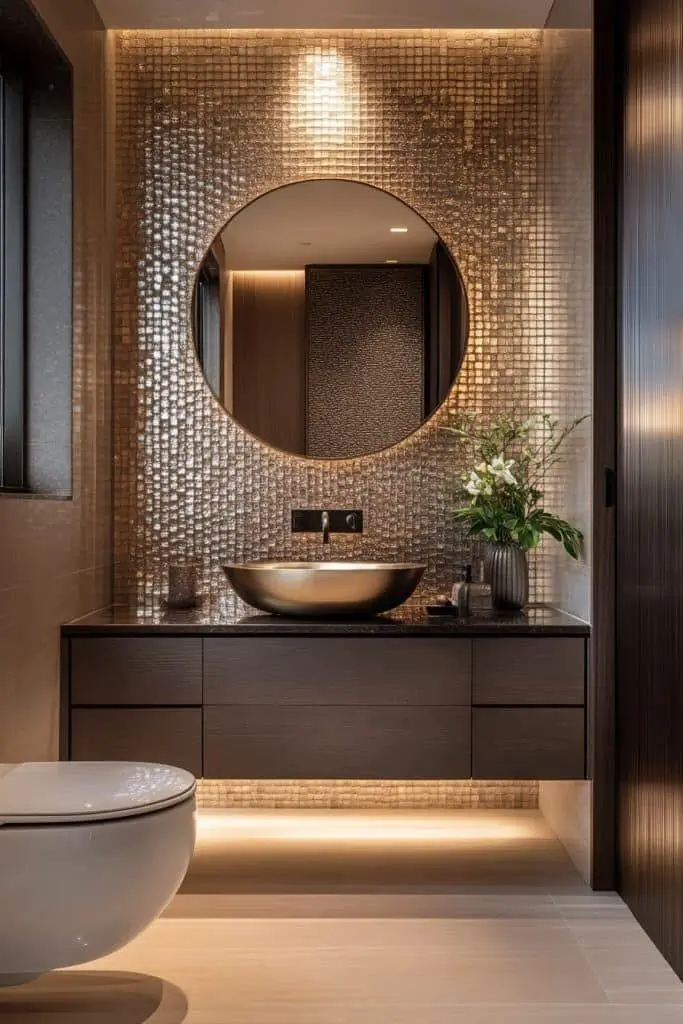
Use one tile for 80 percent of the space and a second tile for 20 percent. That ratio gives you personality without visual chaos.
The problem with using lots of different tiles is that the eye does not know where to go. It bounces from pattern to pattern and the room feels busy. The 80/20 rule solves that.
Pick a large neutral tile as your base. That covers the floors, the main walls, and the shower walls. Then pick a smaller or more decorative accent tile for one surface: the shower niche, a border strip, or the floor inside the shower.
The result is a bathroom that feels designed and personal without being overwhelming.
Pro Tip: Make sure the two tiles share at least one color in common. They do not need to match, but they should relate. A warm stone base tile with a warm terracotta accent works. A cool gray base with a warm orange accent will fight.
Idea 20: Use Through-Body Porcelain for Clean Edges

Most tiles have color only on the surface. When you cut them, the inside shows a different color. That breaks the look at corners and edges.
Through-body porcelain has the same color running all the way through the tile, not just the top layer. When it is cut, trimmed, or installed at a corner, the edge looks consistent with the face. No color break. No visual interruption.
In a small bathroom where tile wraps corners or meets at edges, this matters. Those small details add up. A tile that shows a gray or tan edge at every corner creates subtle noise. A through-body tile keeps every surface looking clean and continuous.
Pro Tip: Through-body porcelain is worth the slight price premium if your tile plan involves a lot of exposed edges or corner trim. Ask your supplier to confirm the tile is full-body before ordering.
5 Tile Mistakes That Make Small Bathrooms Feel Smaller
Knowing what not to do is just as useful as knowing what works.
Using too many tile types in one room. Three or four different tiles in a 40-square-foot bathroom creates chaos. Each type is a new pattern for your eye to process. Pick one main tile and one accent. That is enough.
Dark floor combined with dark walls and no contrast. Dark tile can work in a small bathroom when it is done intentionally. But dark floor plus dark walls with no light surface anywhere creates a room that feels like a box. If you want dark tile, keep the ceiling and at least one wall surface light.
Small mosaic tiles used wall to wall. Penny tiles and small hex tiles are charming. Covering every surface with them makes a room feel like a pattern explosion. Use them on the floor or as a single accent. Not everywhere.
Wide grout lines in a contrasting color. A thick dark grout line on light tile in a small space creates a very visible grid. The room reads as a series of individual tiles rather than a surface. Go thin and go light.
Mixing tile sizes with no logic. A large tile on the floor, a medium tile on the walls, and a small tile in the shower with no visual connection between them makes a bathroom feel random. Every tile size you introduce should serve a purpose and relate to the others.
How to Choose the Right Tile for Your Specific Bathroom
Before you buy anything, answer these four questions.
How much natural light does your bathroom get? If you have one small window or no window at all, go light. White, off-white, pale stone, or soft cream. Light surfaces will do the most work in a dark room. If you have good natural light, you have more flexibility to go slightly darker or bolder.
What is the longest uninterrupted wall in your bathroom? That wall determines your tile layout direction. If the longest wall runs left to right, lay rectangular tile horizontally on it. If the room feels tall and narrow, use vertical layout. Find your longest wall first. Then choose your layout.
What color are your fixtures? Your toilet, vanity, and tub are already fixed. Your tile needs to work with them, not compete. A stark white tile with warm-toned fixtures can look off. Bring a photo of your fixtures to the tile store. Hold samples next to them before deciding.
What is your budget and where should you spend it? The shower wall is the surface you see most in daily use. Spend more there. The area around the toilet and behind the door gets less attention. That is where you can save. Average tile installation cost for a small bathroom in the US runs between 900 and 2,500 dollars as of 2025, depending on tile choice and labor in your area.
Once you have answers to those four questions, get samples. Order five to seven tile samples from TileBar, Floor and Decor, or Home Depot. All of them offer sample programs. Hold the samples against your walls at different times of day. See how they look in morning light and under your bathroom light at night. Do not commit to any tile you have only seen on a screen.
Your Small Bathroom Does Not Need More Space. It Needs Smarter Tile.
You do not have to knock down walls or add a window to make a small bathroom feel bigger. The right combination of tile size, color, layout, and grout can do more than any renovation.
Start with one or two ideas from this list that fit your budget and your current bathroom layout. Large format tile and matching grout are the two highest-impact changes you can make. If you do nothing else, do those.
Then order samples. Test them in your real space. See what your bathroom tells you.
The 20 small bathroom tile ideas in this guide are not trends. They are based on how light, color, and visual perception actually work. That means they will hold up long after any specific style goes out of fashion.
Your bathroom does not need to be bigger. It just needs smarter tile.
Meta Description: 20 expert-backed small bathroom tile ideas that use size, color, and layout to make any bathroom look and feel bigger.