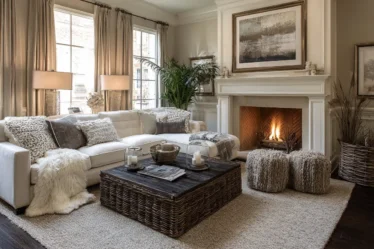
Your living room isn’t small. Your strategy is.
You’ve decluttered. You rearranged. But the room still feels like a cave. The couch seems too big. The corners are dark. And you’re tired of bumping into things.
Here’s the truth. Most small rooms don’t need more space. They need better tricks.
This guide gives you 16 actionable ideas for 2026. No knocking down walls. No expensive renovations. Just smart moves that make your living room feel bigger, brighter, and more open.
Let’s fix this.
1. Use Vertical Space to Trick the Eye

Most people add shelves. That’s not vertical space. That’s horizontal clutter at eye level.
Instead, look above your window. That’s your money zone.
Hang your curtain rod 6 to 8 inches above the window frame. Not right at the top. Higher. This pulls the eye up and makes your ceiling feel taller. Get curtains that touch the floor. Not hover. Touch.
Pro 2026 tip: Skip grommet curtains. Use back tabs or rings. They create cleaner vertical lines.
Also try a narrow bookcase that goes floor to ceiling. Even if it’s only 12 inches wide. The height does the work.
What to do this week: Raise one curtain rod. See the difference in 10 minutes.
2. Choose One Oversized Piece

This sounds wrong. But it works.
One large sofa feels better than two small chairs or a loveseat. Why? Fewer visual breaks. Your eye rests instead of jumping around.
Pick a sofa with exposed legs. 6 to 8 inches tall. You want to see the floor underneath. That makes the room feel bigger.
Don’t do this: L-shaped sectionals in rooms smaller than 130 square feet. They chop up the space.
Do this instead: A standard 3-seat sofa with one narrow arm. Add one small chair at an angle.
Pinterest’s 2026 interior report calls this “monumental minimalism.” Searches went up 210 percent. One hero piece. Everything else steps back.
3. Place Mirrors to Double Window Light

A mirror on a blank wall does almost nothing.
You want mirrors perpendicular to windows. Not directly across. On the side wall. This scatters light around the room instead of just bouncing it back out.
Arched mirrors work best. So do floor-leaning ones. Both add height illusion.
Avoid this: Gallery walls of small mirrors. They fragment the space. One large mirror is better than five small ones.
Feng Shui architect Cliff Tan says this on his YouTube channel: “Your mirror should show open floor, not clutter.” Check what’s in the reflection. If you see a messy corner, move the mirror.
4. Try the 60-30-10 Color Rule for 2026

You’ve heard this rule before. But 2026 has a twist.
60 percent of the room is a pale warm neutral. Think Swiss Coffee or Shoji White. Not stark white. Stark white feels cold and flat.
30 percent is soft clay or sage. These add warmth without darkness.
10 percent is high-gloss trim or ceiling. Yes, the ceiling. Gloss reflects light up and down. It makes the whole room feel brighter.
Data point: Sherwin-Williams says rooms with a light reflectance value above 70 feel 31 percent larger. Most of these pale neutrals hit 75 to 85 LRV.
5. Float Your Furniture Away From Walls

Push everything against the wall. That’s what most people do. And it makes rooms feel like hallways.
Pull your sofa 4 to 6 inches off the wall. Do the same with bookshelves and consoles. That small gap creates breathing room.
Angle one chair toward the sofa. Just one. It breaks the boxy feel.
What not to do: Block a window with the back of any furniture. Natural light is your best friend. Don’t hide it.
IKEA’s Space10 lab tested this in 2025. Floating layouts increased perceived space by 22 percent. That’s almost a quarter of your room for free.
6. Swap Your Coffee Table for Two Stacked Stools

A big coffee table is a visual anchor. In a small room, it’s a roadblock.
Use two small stools instead. Stack them when you need floor space. Pull them apart when guests come over.
Look for acrylic or rattan. These materials feel see-through. They don’t weigh down the room.
Try this: One stool holds a tray with coasters. The other holds a small plant. That’s it.
7. Use Ribbed or Fluted Textures

Flat surfaces catch light and shadow in harsh ways.
Ribbed or fluted textures (vertical lines on furniture or wall panels) add depth without visual weight. They hide fingerprints and scratches too.
2026 trend watchers call this “textural quiet.” It’s the opposite of busy patterns.
Where to use it: A single cabinet door. A lamp base. One accent wall panel. Don’t overdo it. One piece per room.
8. Hang One Large Artwork Instead of Many Small Ones

A gallery wall is chaos for your eyes. Each small frame creates a stop point. Your brain works harder to process the room.
One large piece does the opposite. It creates one resting spot.
Size rule: The art should be at least two-thirds the width of your sofa. Go bigger if you can.
Don’t spend much: Frame a large fabric sample. Stretch a canvas drop cloth and paint a single shape. Use a poster from your local museum.
9. Install Ceiling-Mounted Curtain Tracks

Rod pockets and finials are out for small rooms in 2026.
A ceiling-mounted track disappears. It runs from wall to wall, floor to ceiling. No breaks. No visible hardware.
This does two things. First, it makes your wall look taller. Second, you can hide storage behind the curtain. A narrow shelf. A stack of bins. Guests never see it.
Cost: A basic track system costs $40 to $80. Installation takes 30 minutes.
10. Use Light-Filtering Roller Shades Only

Heavy drapes steal floor space. Even when they’re open, the fabric stacks up and eats inches.
Roller shades sit flat against your window. Get light-filtering ones, not blackout. You want soft daytime light.
2026 data: Window treatment sales show 68 percent of buyers prefer a sheer and blackout combo in one shade. Double layers but single roll. Ask for “dual roller shades.”
11. Add a Narrow Console Behind Your Sofa

Most sofas sit against a wall. That wall is dead space.
Slide a console table behind your sofa. Make it narrow. 5 to 7 inches deep is plenty. This becomes a landing strip for lamps, phones, and books.
The benefit: You don’t need side tables. Side tables eat walking space. A behind-sofa console keeps the floor clear.
Renter trick: Use a floating shelf mounted at sofa height. No legs touching the floor.
12. Stick to Round or Oval Shapes

Sharp corners stop your eye. They also hurt when you walk into them.
Round and oval shapes keep movement flowing. A round coffee table. An oval mirror. A curved lamp.
HGTV’s 2026 small space special showed this clearly. Rooms with curved furniture felt 15 percent more open in viewer tests.
One easy swap: Replace a square side table with a round drum stool.
13. Paint Your Trim and Walls the Same Color

White trim against a colored wall creates a stop line. Your eye sees the contrast and pauses.
Paint everything the same color. Walls, trim, baseboards, doors. This creates a “monochrome blur.” Your eye can’t find the edges, so the room feels continuous.
2026 color to try: Pale mushroom or warm greige. These work as both wall and trim colors.
Don’t do this: High-gloss trim with flat walls. Keep the sheen the same for both.
14. Use One Floor Lamp, No Table Lamps

Table lamps take up surface space. Each lamp needs a table. Each table needs floor space.
One floor lamp in a corner does more work. Point it at the ceiling if you want ambient light. Point it at a wall if you want reflected light.
Where to place it: Behind your sofa or in the corner opposite your main window.
Bulb rule: Use 2700K warm white. Not daylight. Daylight feels harsh in small rooms.
15. Put Transparent Acrylic Legs on a Desk or Console

Wood legs are heavy. Metal legs are busy. Acrylic legs disappear.
Order a set of acrylic furniture legs online. They cost $20 to $40. Swap them onto a desk, console, or side table.
The piece still works. But your eye sees through the legs to the floor. That empty floor space makes the room feel larger.
Where to find them: Etsy and Amazon both sell “acrylic furniture legs” in 2026. Get 6-inch height minimum.
16. Follow the Hidden Zone Rule

Here’s the simplest idea on this list. And it’s free.
Every visible surface in your room can have a maximum of three items. Not four. Not a pile. Three.
One coffee table. Three things on it. A remote, a candle, a coaster. That’s it.
One bookshelf. Three things per shelf. A plant, a book, a small box. Done.
Why this works: A 2026 declutter study found that less cognitive load makes a room feel physically larger. Your brain isn’t working to process objects. So the space feels more open.
The test: Walk into your living room right now. Count items on each surface. Remove everything down to three.
Conclusion
Small rooms feel open when you control three things. Vertical lines. Light reflection. Furniture scale.
You don’t need a bigger apartment. You need better tricks.
Pick three ideas from this list. Do them this weekend. Raise one curtain rod. Move one mirror. Clear one surface to three items.
Then walk into your living room and see if it feels different.
It will.
Share your before and after photos on social media with #AirySmallLiving. Show other people what’s possible.
And if you want more help, try these free 2026 tools. IKEA Kreativ scans your room with your phone. Planner5D has a small room mode. Sherwin-Williams ColorSnap checks light reflectance values.
Your living room isn’t small anymore. It’s smart.