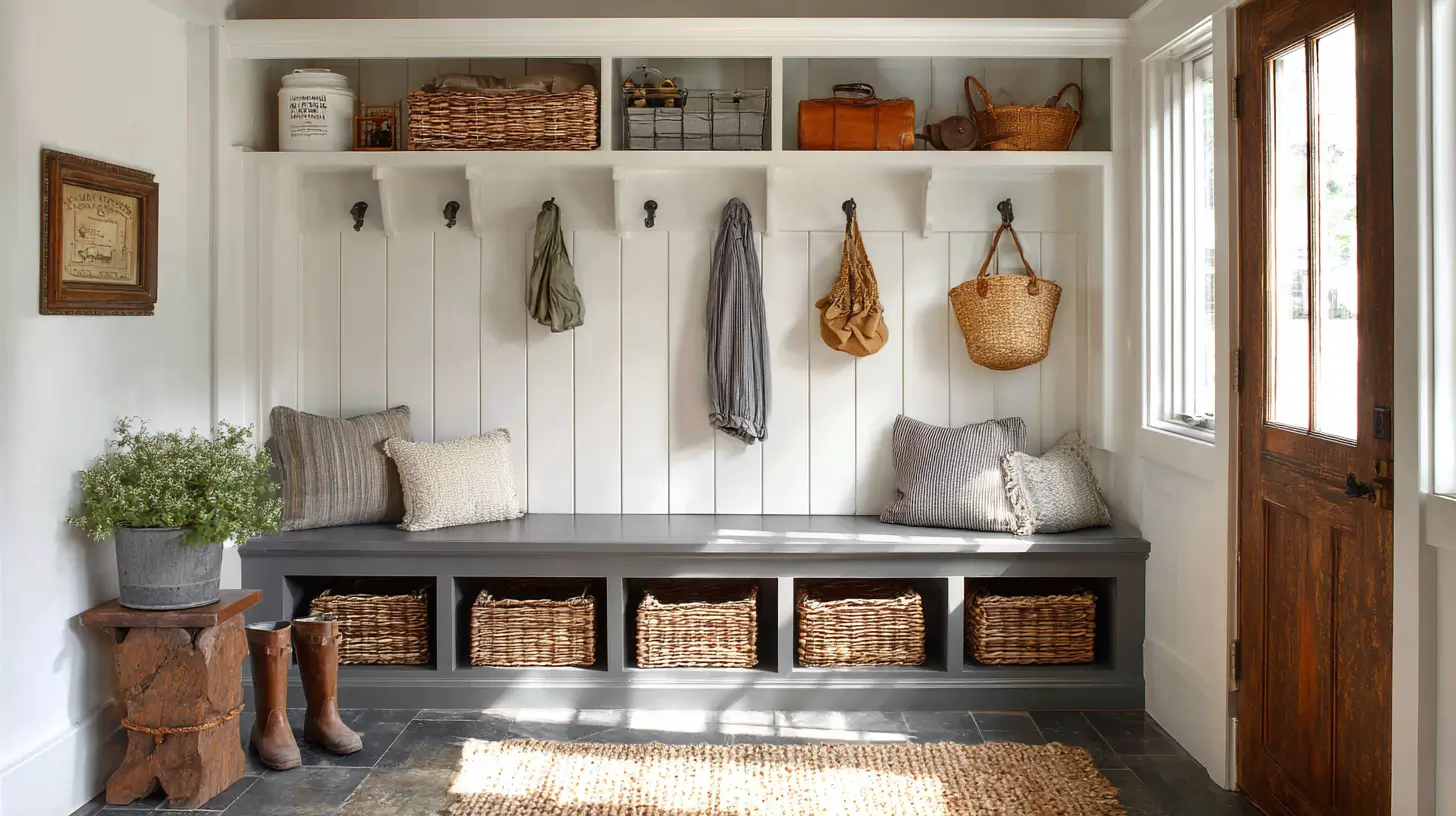
The second you walk through the door, your home either says “welcome back” or “good luck finding a spot to drop your keys.”
If your mudroom is a pile of shoes, a tangle of bags, and a wall of hooks you never use, you are not alone. Most mudrooms are dark, messy, and completely ignored until someone trips over a backpack.
Here is the good news. You do not need a big renovation budget to fix it. You do not even need to call a contractor. Some of the best farmhouse mudroom ideas cost less than a dinner out.
This guide gives you 16 real, specific ideas. Each one includes what it costs, what materials to buy, and how to actually do it. No vague advice. No expensive nonsense. Just clear steps you can use this weekend or plan for later this year.
Whether you have a full laundry room to convert or just a corner near the back door, something in this list will work for your space.
Why a Farmhouse Mudroom Is Worth Your Time
Before you spend a single dollar, it helps to know why this matters.
A messy entryway creates stress you might not even notice. You rush out the door, you come home to chaos, and the whole house feels harder to manage. One organized, good-looking entry space changes that feeling every single day.
The National Association of Home Builders reports that mudrooms rank in the top 5 most-wanted features among home buyers under age 45. Real estate agents call it a closing feature because buyers remember it. A well-done mudroom can add 5 to 10 percent to your resale appeal, especially in family-focused neighborhoods.
On the practical side, a proper mudroom keeps outdoor dirt, wet shoes, and backpacks contained at the door. That means less cleaning in the rest of your house. Having a designated drop zone reduces household clutter by up to 40 percent in main living areas.
Farmhouse style has stayed in the top 3 most searched home design styles on Pinterest every year from 2022 through 2025. It is warm, it is lived-in, and it fits almost any home age or layout.
QUICK WIN: Add a $20 rail with three hooks near your door this weekend. It is the single fastest mudroom upgrade you can make.
1. Shiplap Walls That Set the Whole Farmhouse Tone

Shiplap is the fastest way to make a plain wall look like a farmhouse. It is horizontal wood planks with small gaps between them, and it looks great painted white, cream, or sage green.
You do not need to rip out your drywall to get the look. Here are your three options:
Real shiplap boards: Pine or MDF boards from Home Depot or Lowe’s run $1 to $3 per square foot for materials. Add $8 to $12 per square foot for professional installation.
Peel-and-stick shiplap wallpaper: Brands like NuWallpaper and Tempaper make realistic versions available at Target and Home Depot. Great for renters. Cost is about $30 to $50 per roll, covering roughly 28 square feet.
Self-adhesive wood planks: These click-on panels install without nails and are repositionable. Cost is $2 to $4 per square foot.
For small mudrooms, run the planks vertically. It makes the ceiling look taller. In larger spaces, go horizontal for that classic barn wall look.
Paint both the shiplap and the trim the same color for a clean, pulled-together finish. White Dove by Benjamin Moore and Alabaster by Sherwin-Williams are the top two choices for farmhouse shiplap in 2025 and 2026.
PRO TIP: Buy a 5-pack of peel-and-stick paint samples before committing. The color looks different under mudroom lighting than it does in a bright store.
2. Built-In Bench and Cubby Storage: The Heart of the Mudroom
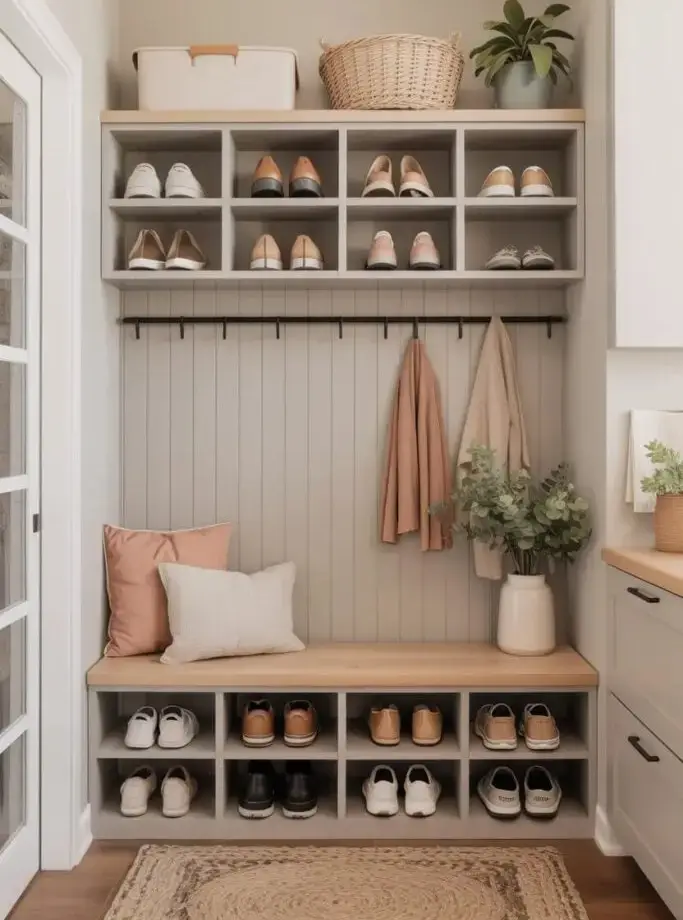
Walk into any well-designed mudroom and the first thing you notice is the built-in bench with cubbies above it. There is a reason every designer puts this in. It gives every person in your household a spot. Shoes go below. Bags and backpacks go in the cubby. Coats hang above. Done.
Here are the dimensions that actually work:
Bench height: 17 to 19 inches. This is standard seat height, so it is comfortable to sit on while putting on shoes.
Cubby width: 12 to 15 inches per person. A family of four needs at least 48 to 60 inches of total width.
Cubby depth: 16 to 18 inches. Deep enough for a backpack to sit fully inside.
You have two budget paths. The IKEA Kallax hack is the most popular option on Pinterest, with over 2 million saves. You buy Kallax shelving units, add a plywood bench top, wrap the front in beadboard paneling, and paint everything white. Total cost: $150 to $300 depending on size.
Custom built-ins from a local carpenter run $1,200 to $3,500 depending on size and materials. They look better and last longer, but the IKEA version works just as well for most families.
Add beadboard panels inside each cubby to bring in farmhouse texture at almost no extra cost. Beadboard paneling runs $0.80 to $1.50 per square foot for DIY installation.
PRO TIP: Use a formula to figure out how many hooks you need. Number of people in your household times 2 equals your minimum number of hooks. A family of four needs at least 8 hooks.
3. Vintage-Style Hooks That Work as Hard as They Look

Most people hang one row of hooks and call it done. But the wrong hooks in the wrong spot make your mudroom look like a gym locker room, not a farmhouse.
Here is what works:
Height for adult coat hooks: 60 to 66 inches from the floor.
Height for kids: 40 to 48 inches. Add a second lower row so small kids can reach.
Spacing between hooks: At least 4 inches apart. Otherwise coats overlap and look crammed.
For farmhouse style in 2026, the top three finishes are matte black, cast iron, and antique brass. Matte black overtook brushed nickel as the number one farmhouse hardware finish in 2024 according to Houzz renovation data. It looks sharp against white shiplap.
Double hooks are worth it. A double hook holds both a coat and a bag without adding any more wall space. They increase your storage by about 40 percent compared to single hooks.
Where to buy: Etsy has the best selection of handmade and vintage farmhouse hooks. Amazon has affordable cast iron sets. Anthropologie carries more decorative options. Budget: $5 to $25 per hook depending on quality and style.
QUICK WIN: Replace your existing hooks with cast iron double hooks this weekend. It takes 20 minutes and costs under $50 for a set of five.
4. Sliding Barn Doors That Save Space and Add Character

If your mudroom has a door leading to the laundry room, garage, or a closet, swap it for a sliding barn door. This is one of the most dramatic changes you can make.
A standard door needs 10 to 14 square feet of swing clearance. A barn door uses zero floor space because it slides along the wall. In a tight mudroom, that extra floor space matters a lot.
In 2026, the most popular barn door styles for farmhouses are:
Solid wood plank doors painted white or in a natural stain.
Glass panel barn doors for small spaces where you want to keep light moving.
Bypass doors (two doors that slide past each other) for laundry and mudroom combos.
Hardware finish: matte black is still the top choice, but antique bronze is growing fast in 2025 and 2026.
Cost breakdown: A DIY barn door kit from Home Depot or Amazon runs $200 to $600. This includes the door, track, and hardware. Professional installation adds another $400 to $800 in labor. If you are handy, this is a great DIY project. Most installs take four to six hours.
Barn door search volume on Houzz grew 28 percent between 2022 and 2024. That growth has held steady.
5. Subway Tile Floors That Are Beautiful and Easy to Clean

Mudroom floors take serious abuse. Wet boots, muddy paws, dropped backpacks. You need a floor that can handle all of it and still look good.
Subway tile is the answer. It has been a top 5 choice for entryways and kitchens for over a decade because it works. It is durable, easy to wipe clean, and it looks classic.
Your key decisions:
Size: Classic 3×6 white subway tile is timeless. The 4×8 and 4×12 sizes feel more modern and are trending in 2025 and 2026.
Pattern: Laying tiles in a herringbone pattern adds visual interest and costs nothing extra because you are using the same tiles.
Grout color: This matters more than most people think. White grout shows every stain. Charcoal or medium gray grout hides dirt and requires far less maintenance. Pick gray grout and you will thank yourself in six months.
Cost: Subway tile runs $1.50 to $4 per square foot for materials. Installation adds $5 to $12 per square foot. For a 50-square-foot mudroom floor, total installed cost is $325 to $800.
One honest note: tile is cold in winter. If you live somewhere with harsh winters, consider adding a small area rug or a heated floor mat near the entry bench. It costs $40 to $80 and makes a big difference in winter months.
6. Open Shelving with Baskets: Organized Chaos Done Right

Open shelving looks great in farmhouse spaces. The trick is that it only looks good when each basket or bin has one specific job. If everything just gets dumped in, it looks messier than no shelves at all.
The system that works: one basket per category, labeled clearly.
One basket for sports gear. One basket for dog items (leashes, treats, bags). One basket for mail and keys. One basket for seasonal items (hats, gloves, sunscreen).
For farmhouse style, use seagrass, wicker, or wire baskets. Seagrass basket sales on Amazon grew 45 percent between 2022 and 2024. They look natural and age well. The Container Store reports baskets and bins as their top-selling organizational category every year.
For shelves, floating pine or oak boards with black pipe brackets or corbel brackets fit the farmhouse look perfectly. Pine boards run $8 to $20 each. Black pipe brackets cost $5 to $12 each. A set of three shelves with hardware comes to $60 to $120 total.
Add chalkboard or printed labels to every basket. It takes five minutes and keeps the system working long-term.
PRO TIP: Spend $15 on a label maker. Labeled baskets get used correctly. Unlabeled ones become catch-alls within two weeks.
7. A Storage Bench with Hidden Shoe Space Underneath

Shoes are the number one mudroom problem. They multiply, they smell, and there is never enough room for them. A storage bench with a flip-top lid or open cubbies underneath solves this completely.
A flip-top bench hides 8 to 12 pairs of shoes inside, keeps them out of sight, and gives you a clean surface to sit on. It looks tidy even when life is not.
Your two options:
Buy one ready-made: Wayfair and Amazon both list flip-top storage benches as their number one result for “mudroom bench” as of 2025. Prices range from $80 to $250 depending on size and material.
Build one: A basic DIY bench uses 2×4 framing, a plywood box, and shiplap or beadboard on the front. DIY bench tutorials for farmhouse mudrooms are some of the most-watched home builds on YouTube, with several videos earning over 1 million views. Materials cost $50 to $120.
For the bench top, you have two choices. A slatted wood top looks great but is hard to sit on barefoot in winter. An upholstered cushion is comfortable but needs fabric that can handle moisture and dirt. Use outdoor fabric or Sunbrella material. It resists stains and dries fast.
Style the bench top with one or two throw pillows in grain sack fabric or a classic stripe. It makes the whole mudroom look more intentional.
8. A Chalkboard Wall or Vintage Sign for Real Personality

This is where a lot of people skip past because it feels optional. It is not. The difference between a mudroom that feels functional and one that feels like a real part of your home is personality.
A chalkboard wall section gives your family a place to write schedules, leave notes, or let kids draw. Use chalkboard paint, which costs $15 to $25 per quart and covers up to 75 square feet. Tape off a clean rectangle, apply two coats, and you are done in an afternoon.
If chalkboard is not your thing, vintage signs work just as well. Look for signs with words like “Boots and Shoes,” “Welcome Home,” or farm animal motifs. The best places to find real vintage signs:
Facebook Marketplace: Antique and vintage listings grew 60 percent between 2022 and 2024. Prices are negotiable and often very low.
Etsy: Huge selection of handmade farmhouse signs in custom sizes and paint colors.
Local flea markets and estate sales: The most authentic finds at the lowest prices.
One tip: do not go overboard. One chalkboard section or one or two vintage signs is perfect. Three or more starts to look cluttered, which defeats the purpose of a tidy mudroom.
9. Warm Lighting That Changes How the Whole Room Feels

Most mudrooms have one ceiling light with a basic builder-grade fixture. That single light casts flat, cold light on everything, making the space feel like a storage unit instead of a welcoming part of your home.
Fix this with warm light. Lighting designers recommend 2700K to 3000K color temperature for entryways. That is the warm yellowish-white you see in cozy restaurants and living rooms. Swap your bulbs first. It costs $10 and takes two minutes.
Then upgrade the fixture. Good options:
Schoolhouse globe pendant: One pendant over the bench area makes a big impact. Prices start at $40 on Amazon and go up to $150 at Rejuvenation and West Elm. Schoolhouse pendant searches grew 40 percent on Wayfair between 2023 and 2025.
Wall sconces with Edison bulbs: Mount two sconces on either side of a mirror or on the shiplap wall. Edison bulbs add warm, visible filament light that fits farmhouse style perfectly.
Motion-sensor puck lights inside cubbies: These cost under $20 for a pack and make it easy to find things at night.
If you want to go further in 2026, smart bulbs from Philips Hue or LIFX let you schedule your mudroom lights to turn on automatically when you arrive home. Cost is about $15 to $25 per smart bulb.
10. Shiplap Plus Beadboard for Layered Wall Texture

Shiplap alone looks great. Beadboard alone looks great. Together, they look like a home that was built with real care and intention.
Here is how to do it: put beadboard wainscoting on the lower half of the wall, from the floor up to about 36 to 42 inches. Add a simple chair rail molding at the top of the beadboard. Then run shiplap on the upper half of the wall, from the chair rail to the ceiling.
Paint both sections the same color, like white or cream, for a clean unified look. Or paint the lower beadboard section a soft contrast color like sage green or dusty blue to add depth. This two-tone approach is one of the strongest trends in farmhouse design for 2025 and 2026.
This combination works especially well in narrow mudrooms. The horizontal shiplap on top draws the eye across the wall and makes the space feel wider. The vertical lines in the beadboard below add structure without making the ceiling feel lower.
Cost: Beadboard paneling runs $1 to $2 per square foot for DIY panels. Chair rail molding costs $1 to $3 per linear foot. Combined with shiplap, a full mudroom wall treatment for a 6×8 foot space runs $80 to $200 in materials.
11. A Utility Sink: Practical and Worth Every Penny

If your mudroom connects to a garage, back yard, or laundry area, a utility sink is one of the most useful things you can add. Parents with young kids say it pays for itself in the first month. Pet owners say the same.
Muddy hands, garden vegetables, dog paws, athletic equipment: all of it gets handled at the sink before it enters the rest of your house.
Your options:
Standard utility sink: White or stainless steel, wall-mount or cabinet-base. Prices start at $80 at Home Depot. Functional and no-nonsense.
Farmhouse apron sink: The iconic look, with an exposed front panel. Brands like Kohler and American Standard make utility-grade apron sinks for $300 to $900. This is the option that looks beautiful and works hard.
Plumbing is the biggest cost factor. If your mudroom is near existing water lines, adding a sink connection runs $500 to $1,200 in labor. If it requires new pipes through walls or floors, costs can reach $2,000 or more. Get two or three contractor quotes before committing.
Houzz 2024 renovation data lists utility sinks as a top 5 requested feature in mudroom and laundry renovations. If you are thinking about resale, this addition resonates with buyers.
HONEST NOTE: This is not a DIY project unless you have plumbing experience. Hire a licensed plumber. A botched pipe connection behind a wall costs far more to fix than the original job.
12. Reclaimed Wood Accents for Real Rustic Charm

New wood looks clean. Reclaimed wood looks like history. In a farmhouse mudroom, that history is exactly what you want.
You do not need to panel an entire wall in reclaimed wood. A single floating shelf, a bench top, or a framed mirror in reclaimed wood does the job. It adds warmth and texture that brand new materials just cannot match.
Where to find reclaimed wood in 2026:
Habitat for Humanity ReStore: Over 900 US locations carry reclaimed lumber, doors, and architectural pieces at very low prices.
Local salvage yards: Search for “architectural salvage” plus your city. Prices vary, but deals are common.
Craigslist and Facebook Marketplace: Search “old barn wood” or “reclaimed lumber.” You can often get it free or for very little from people clearing out old structures.
Etsy: Sellers ship cleaned and prepped reclaimed boards nationwide. Prices run $3 to $8 per square foot.
Before using reclaimed wood inside your home, clean it with a stiff brush and a diluted bleach solution. Sand lightly if needed. Then seal with a clear matte finish or danish oil to protect it from moisture.
Pair reclaimed wood elements with white or cream painted surfaces. The contrast between weathered brown wood and fresh white paint is the farmhouse look in its purest form.
13. The Right Color Palette: What Actually Looks Farmhouse in 2026

Color is where many farmhouse mudrooms go wrong. People paint everything white and wonder why it still does not feel warm. Or they pick trendy colors that clash with the rest of the house.
Here is a simple system that works:
Pick one main wall color: Classic farmhouse uses white, cream, or soft gray. In 2026, warm sage green and dusty blue are both strong choices. Sage green Pinterest searches grew over 200 percent between 2021 and 2024.
Keep trim and molding white: Always. White trim grounds every other color and makes the space feel finished.
Add one warm accent: This can be a brown bench top, tan baskets, rust-colored cushion, or natural wood shelf. One warm accent stops the room from feeling cold.
Top paint picks for 2026 farmhouse mudrooms:
Benjamin Moore White Dove (OC-17): Clean, warm white. The most-saved farmhouse white on Pinterest.
Sherwin-Williams Accessible Beige (SW 7036): A warm neutral that works with brown, green, and white tones.
Benjamin Moore Pale Smoke (1580): A dusty blue-gray that feels calm and farmhouse at the same time.
Sherwin-Williams Sage (SW 0017): A muted earthy green that is growing fast in 2025 and 2026.
Before you paint, test your color on the actual wall. Peel-and-stick paint samples from Samplize cost $5 to $7 each and let you see the color under your exact lighting. This service grew 300 percent in sales between 2021 and 2024 because people stopped guessing and started testing.
14. Small Space and Apartment Mudroom Solutions That Actually Work

You do not need a whole room to have a mudroom. You need a system. Even a corner of a hallway or a converted coat closet can function as a proper farmhouse mudroom.
If you rent, here is good news: 36 percent of US households are renters according to US Census 2024 data, and most of these ideas work in rental spaces with zero damage to the walls.
Options by space size:
Under 4 feet of wall space: One hall tree unit from Wayfair or IKEA gives you hooks, a bench, a shelf, and sometimes a mirror all in one freestanding piece. Prices range from $120 to $400. No drilling required.
A coat closet: Remove the rod and add two rows of hooks on the back wall, a shelf above, and a small bench or shoe rack below. Done in two hours. Cost: $50 to $150 in hardware and a shelf board.
A corner (4×4 feet): Place an L-shaped bench in the corner and add hooks to both walls above it. This setup fits four to six people and uses space that was otherwise wasted.
For renters who want the shiplap look, NuWallpaper and Tempaper both make peel-and-stick shiplap wallpaper. These are sold at Home Depot and Target. They go up in an hour, remove cleanly, and leave no wall damage.
PRO TIP: Before buying a hall tree, measure your ceiling height. Many hall trees with shelves are 75 to 80 inches tall and will not fit in spaces with 7-foot ceilings.
15. The Pet-Friendly Farmhouse Mudroom
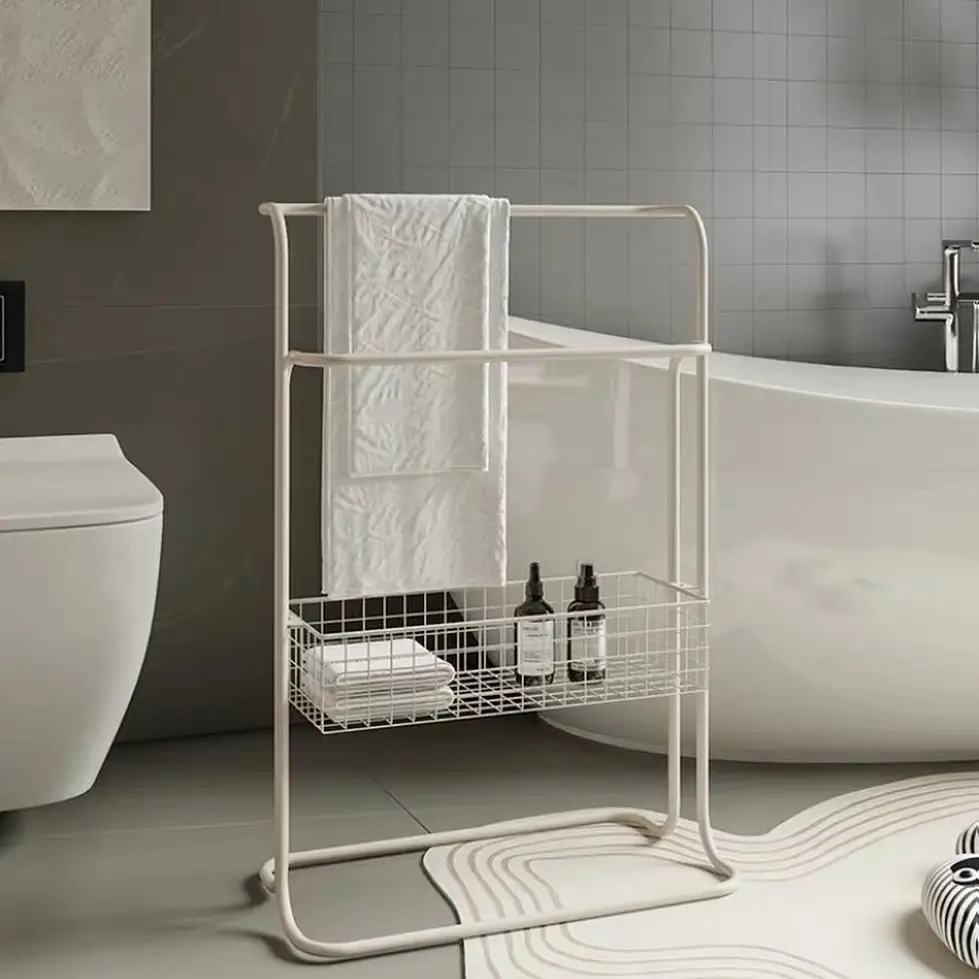
If you have dogs or outdoor cats, your mudroom has a very specific job: stop the mess before it hits the rest of the house.
Here is what a pet-ready farmhouse mudroom needs:
A hook or cubby just for leashes, collars, and bags. Keep all pet gear in one spot so walks actually happen on time.
A low mounted hook or peg rail at 24 to 30 inches from the floor for leashes kids can grab.
A basket for dog towels near the door. Buy six cheap white towels and keep them in a labeled basket. Wipe paws before the dog goes any further.
A mat or tray under the dog bowl if you keep food and water near the entry. This catches spills and keeps the floor clean.
If you have the space, a small utility sink (covered in idea 11) is the single biggest upgrade for pet owners. Washing muddy paws in a dedicated sink instead of your bathtub changes everything.
For flooring near the dog entry, skip carpet or soft rugs. Use a rubber-backed washable mat or stick with your tile or hardwood floor. Washable mats from brands like Ruggable run $80 to $200 and go straight into the washing machine.
QUICK WIN: A $12 wall-mounted leash hook near the door is the fastest pet mudroom upgrade you can make. If the leash has a home, walks actually happen.
16. Real Cost Breakdown: What a Farmhouse Mudroom Actually Costs

Let us be direct about money. Here are three realistic budget tiers and what each one gets you.
BUDGET TIER ($200 to $600):
New hooks: $25 to $60 Peel-and-stick shiplap wallpaper: $60 to $100 A few seagrass baskets with labels: $30 to $80 Fresh paint and supplies: $35 to $80 A basic hall tree or freestanding bench: $80 to $250
This tier delivers a completely different-looking mudroom. You can finish it in one weekend. It will not look like a renovation. It will look like someone who cares lives there.
MID-RANGE TIER ($1,000 to $3,000):
Real shiplap or beadboard wall: $300 to $600 in materials IKEA Kallax bench hack: $150 to $300 Statement light fixture: $80 to $200 Small tile area or new floor mat: $100 to $400 New hooks, baskets, and paint: $100 to $300
This is the most popular tier for family homes. It delivers strong results without a full renovation.
HIGH-END TIER ($5,000 to $12,000 and up):
Custom built-in bench and cubbies, real subway tile floor, professional shiplap installation, a utility sink, and new wiring for lighting. This is a full renovation with contractor work involved.
According to Angi, the average cost to renovate an existing mudroom in the US runs $1,500 to $5,000. Adding a mudroom to a space that was not previously one runs $8,000 to $15,000.
The smartest move: phase your project. Start with hooks and paint this month. Add a bench next quarter. Do the floor when you are ready. A great mudroom does not have to happen all at once.
MONEY FACT: A $2,000 mudroom used twice a day for 10 years costs you about $0.27 per use. That is a good investment.
Start With One Thing and Build From There
A farmhouse mudroom is not about perfection. It is about having a space that works for your family and feels good to come home to.
You do not need every idea in this list. Pick one thing that solves your biggest current problem. If shoes are everywhere, start with the storage bench. If the wall looks bare and plain, start with hooks and shiplap wallpaper. If the whole room feels dark, swap the light fixture and change the bulbs.
Small changes stack up fast. Most families who start with one weekend project end up doing two or three more because the first one makes such a clear difference.
Pick your idea, buy your materials, and do it this weekend. Your future self, walking through the door after a long day, will notice.
Whether you start with a $20 set of hooks or a full shiplap wall, these farmhouse mudroom ideas prove you do not need a big budget. You just need a clear plan and a little time.